How to find your ancestors: a beginner’s guide
Finding your ancestors means working backwards one generation at a time, from what your family knows to what records can prove. This guide shows where to look first, which records name the most people, and how to keep your findings organised in a family tree.
By the Family Tree Studio team · Published · Updated · Checked against the editor it describes
1. Start with yourself and work backwards
Genealogy runs in one direction: from the known to the unknown. Write down yourself, your parents and your grandparents with whatever you know: full names, birth surnames, roughly when and where they were born, married and died. Each generation you confirm gives you the names, dates and places you need to search for the one before.
Resist the urge to start with a famous person who shares your surname and work down. It is the most common way to end up with somebody else’s ancestors.
2. Talk to older relatives
The oldest members of your family are the most valuable and most time-limited source you have. Visit or call them, take notes or record the conversation with permission, and bring old photos to prompt memories. Useful questions:
- What were your parents’ and grandparents’ full names, including surnames before marriage?
- Where did they live, and did the family move? Which town, village or district?
- Roughly when were they born, married and when did they die? Where are they buried?
- What did they do for work? Did anyone serve in the military or emigrate?
- Were there brothers, sisters or children who died young, or second marriages?
- Who else in the family kept papers, photos or a written family history?
Ask for places and approximate years rather than exact dates. “Born in Multan, a few years before Partition” is a better clue than a guessed date. Write down who told you each fact.
3. Search for papers at home
Before paying for anything, look through what the family already has. Ask relatives to check their drawers and boxes too:
- Birth, marriage and death certificates, passports, identity cards and naturalisation papers
- Marriage contracts such as a nikah nama, wedding cards and invitations
- Family Bibles, handwritten family trees and shajras kept by elders
- Letters, diaries, address books and funeral or memorial cards
- Photographs, especially with names or dates written on the back
- School reports, military service papers, property deeds and wills
Photograph or scan everything and note who owns the original. A single certificate can name parents, addresses and witnesses who are relatives.
4. Birth, marriage and death records
Civil registration records are the backbone of family history research. A birth record usually names both parents; a marriage record names the couple, often their ages, addresses and fathers; a death record gives an age and sometimes the parents or spouse. Together they let you climb one generation at a time.
Registration began at different times in different countries and regions, from the 1800s in much of Europe and North America to the 1900s elsewhere. Search the indexes for the place where the event happened, then order or view the full record: indexes often leave out the most useful details.
5. Census records
Many countries counted their population every ten years and recorded each household by name. Older censuses that have been released to the public list everyone living at an address, their ages, relationships to the head of the household, occupations and often birthplaces. Following one family through several censuses shows children being born and leaving home, and the birthplaces point you to the next records to search.
Ages and spellings in censuses are often approximate. Use them as clues that a certificate or register can confirm.
6. Religious, community and other records
Before civil registration, births, marriages and burials were usually recorded by religious communities: church baptism, marriage and burial registers, mosque and madrasa records, and temple or community registers. In some Hindu families, genealogy registers kept by priests at pilgrimage places such as Haridwar record visits and family members across many generations.
Also worth searching:
- Gravestones and cemetery records, which often name spouses and children.
- Newspapers: birth, marriage and death notices, obituaries and local news.
- Immigration and travel records: passenger lists, naturalisation files and passports.
- Military records: service files, pension papers and war memorials.
- Land, tax and probate records: wills and property transfers name heirs and relationships.
7. Archives, libraries and genealogy websites
National and regional archives hold most original records, and many have free online catalogues. Public libraries and family history societies often offer free access to subscription websites and local knowledge. Free genealogy websites such as FamilySearch host large collections of indexes and record images; commercial websites add more collections for a fee.
When a record is found online, save the image, the website and the collection name. You will want to find it again.
8. DNA tests
Consumer DNA tests compare your DNA with other testers. They can confirm a suspected relationship, find living cousins who have researched other branches, and estimate broad regions of origin. They do not hand you a list of ancestors: matches become meaningful when you compare them with a researched family tree.
DNA results also reveal information about your relatives and can uncover unexpected parentage. Read the company’s privacy settings first, and think about how you would handle a surprise.
9. Check your evidence
- Prefer records made at the time. A birth record made the week of the birth beats an age given decades later.
- Be careful with common names. Two people with the same name in the same district are common. Compare ages, places, spouses and parents before deciding they are one person.
- Treat online trees as clues. Check each fact against a record before adding it.
- Record uncertainty honestly. Write “abt 1890” or “bet 1888 and 1892” and a note, rather than a precise guess.
- Note conflicts. When two sources disagree, keep both in a note and say which you trust and why.
10. Keep it organised in a family tree
As your research grows, a family tree keeps everyone connected and stops facts from getting lost in notebooks. In this free family tree maker you can record each person’s names and also-known-as names, dates as precise or approximate as you know them, places, life events, notes and the sources you used. Tree health lists people entered twice so you can merge them.
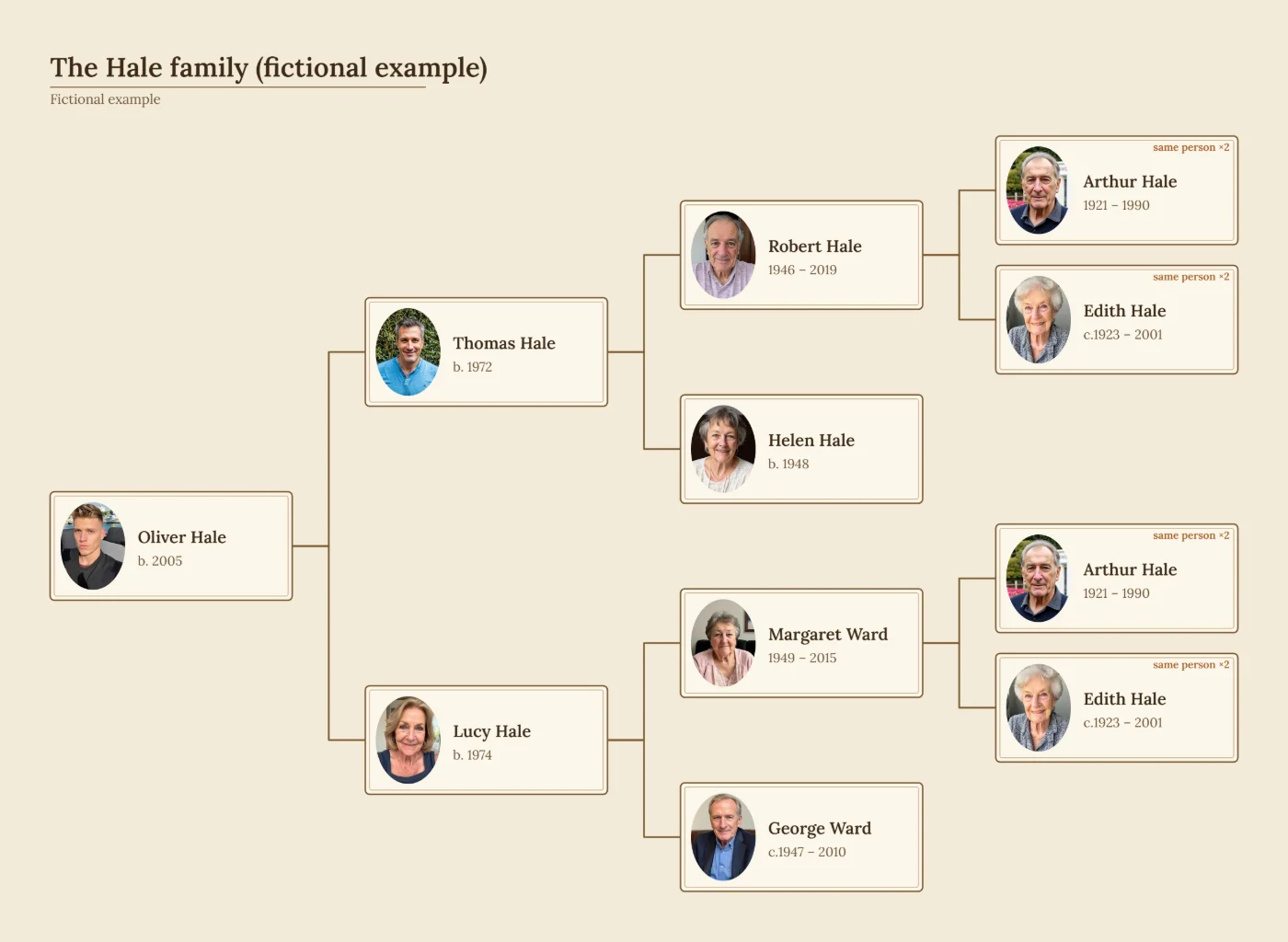
Print a pedigree or fan chart to take to family gatherings: relatives fill in gaps much more readily when they can see the tree. If you use another genealogy program as well, move your tree between them with a GEDCOM file.
Questions about finding ancestors
How far back can I trace my family tree?
Most families can reach their great-grandparents from memories and papers at home, and often three or four generations further with civil and census records. How far you get depends on which records survive where your ancestors lived; many people reach the early 1800s, and some lines go much further through church, land or community registers.
How can I find my ancestors for free?
Start with relatives and papers at home, which cost nothing. Free genealogy websites such as FamilySearch, national and state archives, and public libraries give free access to many indexes and record images. Paid websites add more collections, but they are not needed to begin.
How do I find my grandparents’ or great-grandparents’ names?
Ask the oldest relatives first, then look at your parents’ birth or marriage certificates, which often name their parents. Death certificates, gravestones, obituaries and census records listing whole households usually lead back another generation.
What if the records were destroyed or never kept?
Look for the same facts in other places: community and religious registers, newspapers, land and tax records, school and military records, or relatives’ papers. Write down what you tried, and record what you believe as uncertain until something confirms it.
Can a DNA test tell me who my ancestors were?
A DNA test can match you with living relatives and estimate where some of your ancestors came from, but it does not name ancestors by itself. Matches are most useful alongside a researched family tree. Think about privacy first: your results also reveal information about your relatives.
Should I copy family trees I find online?
Use them as clues, not as facts. Check each name and date against a record before adding it to your tree, and note the source. Copied mistakes spread quickly from tree to tree.
Start recording what you find
Add yourself, your parents and grandparents today, and build backwards as each record turns up.